Markets
ICICI Bank vs Bajaj Finance: Which Got the Market's Thumbs Up — And Why?
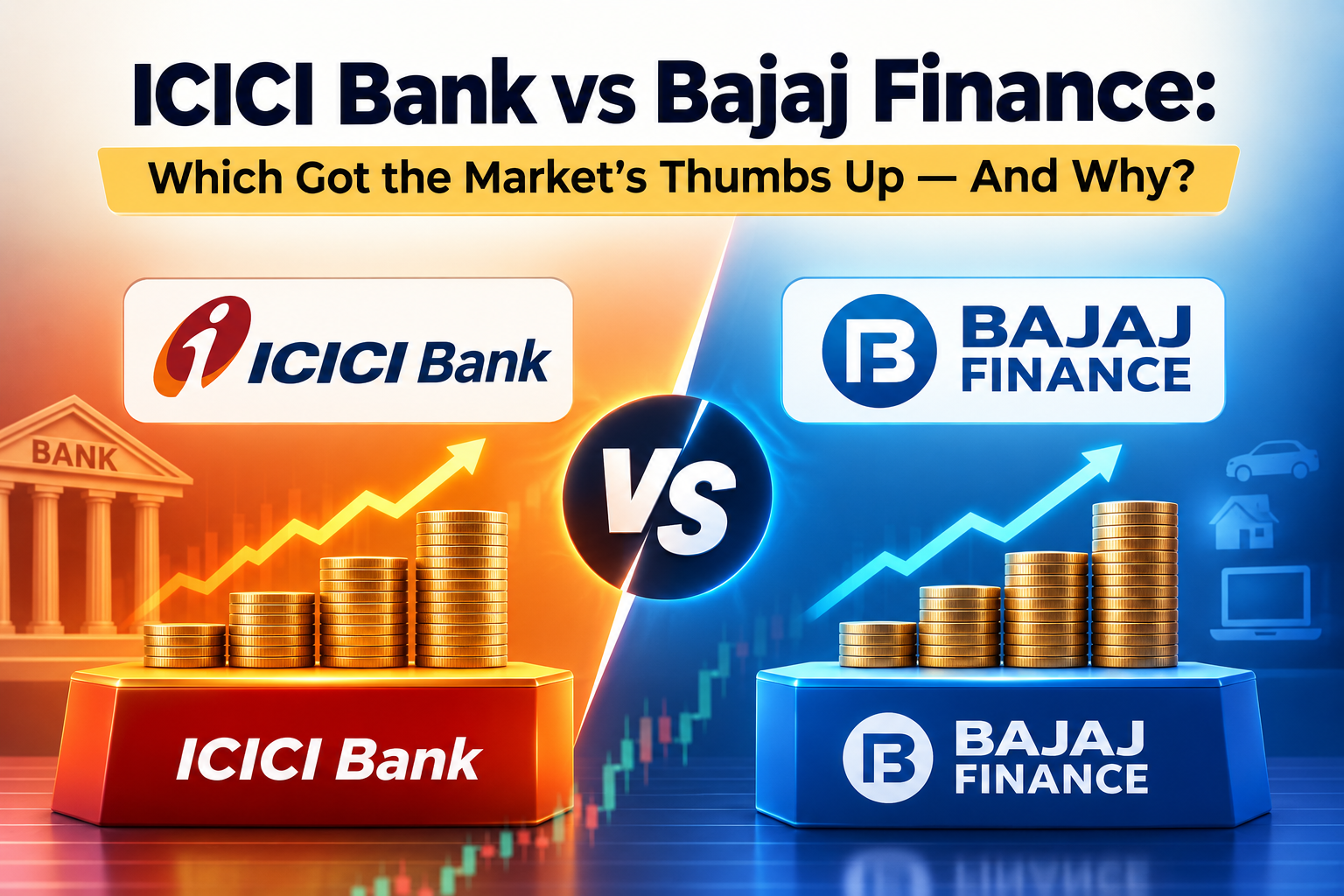
Two Strong Quarters. Two Very Different Market Reactions.
The Q1 FY27 earnings season produced two standout performers in India's financial sector.
ICICI Bank reported another quarter of stellar execution — around 16% year-on-year profit growth, industry-leading asset quality, and one of the highest Net Interest Margins (NIMs) among large Indian banks.
Bajaj Finance, meanwhile, delivered an equally impressive quarter — and was rewarded with an almost 10% surge to a fresh 52-week high.
The contrasting market reaction raises an important question: if both companies delivered excellent numbers, why did investors celebrate one far more enthusiastically than the other?
The Conventional View
The standard explanation is that Bajaj Finance changed future expectations, while ICICI Bank merely confirmed an already well-established investment thesis.
Markets tend to reward improvements in expectations more than they reward consistency.
A company that surprises gets repriced. A company that delivers exactly what was expected stays exactly where it was.
The Bigger Question
However, that explanation leaves one important puzzle unanswered.
ICICI Bank reached its previous 52-week high nearly a year ago. Since then:
- Profits have continued to grow
- Book value has expanded
- Return ratios have remained strong
- Asset quality has kept improving
- Its deposit franchise has strengthened
The stock has effectively undergone a time correction — staying flat in price — while the underlying business has continued to compound.
That is worth pausing on.
The Valuation Paradox
Bajaj Finance already trades at a substantially richer valuation multiple than ICICI Bank.
Yet after one strong quarter, investors were willing to assign it an even higher valuation.
ICICI Bank, despite delivering sector-leading profitability and among the highest NIMs in Indian banking, has not received a similar rerating.
| Company | Q1 FY27 Profit Growth | Market Reaction | Valuation Multiple |
|---|---|---|---|
| ICICI Bank | ~16% YoY | Muted | Lower |
| Bajaj Finance | Strong beat | ~10% surge to 52-week high | Higher — and expanded further |
The paradox: the stock that is already more expensive became more expensive. The stock that is arguably cheaper on fundamentals stayed flat.
What This Tells Us About How Markets Actually Work
The market is not simply rewarding good results.
It is rewarding change in the narrative about a company's future.
-
Bajaj Finance's results strengthened belief in a higher future growth trajectory — investors updated their view of where the company could be in three to five years
-
ICICI Bank's results reinforced a story investors already believed — there was nothing new to reprice, even though the execution remained excellent
This is a critical insight for any investor watching quarterly results:
Markets pay for change in expectations — not just for excellence in delivery.
A company that consistently does what it said it would do may be building tremendous value inside the business. But the stock may not move until something changes the market's forward estimate — either upward or downward.
Why This Is Genuinely Puzzling
The standard narrative does explain the short-term price reaction.
What it does not explain is the magnitude of the gap.
ICICI Bank is among the best-run large banks in India by almost every measurable metric:
- Lowest non-performing assets among large private banks
- Among the highest NIMs in the sector
- Consistent double-digit profit growth
- A deposit franchise that has grown steadily
- Return on equity well above the industry average
A business of this quality, continuing to compound quietly while the stock stays flat, raises a legitimate question for long-term investors: is this a business the market is currently undervaluing while it waits for a new catalyst?
Lumic Take 💡
The market's enthusiasm for Bajaj Finance is understandable. Strong results from an NBFC that had faced growth concerns in prior quarters genuinely changed expectations — and markets repriced accordingly.
The restrained reaction to ICICI Bank is understandable too. Consistency, however impressive, rarely triggers a rerating.
What deserves scrutiny is the magnitude of the difference.
If ICICI Bank continues delivering industry-leading execution while peers lag, one of two things is likely to happen over time:
-
The current valuation will eventually prove more than justified — and long-term investors holding through the time correction will be rewarded
-
The market will find a catalyst to rerate the stock — and the repricing will happen quickly when it does
Bajaj Finance won the quarter.
ICICI Bank may still be winning the marathon.
What Should a New Investor Take From This?
If you are just starting to understand how markets work, this comparison teaches three things:
1. A rising stock is not always the better business Bajaj Finance's price went up more. That does not automatically make it the stronger long-term investment from here.
2. Flat price does not mean a flat business ICICI Bank's stock went sideways for nearly a year while profits, asset quality, and book value kept improving. The business compounded. The price did not — yet.
3. Market timing and business quality are different things You can have an excellent business in a phase where the market simply is not paying attention to it. Understanding that difference — and being patient when you spot it — is one of the foundations of long-term investing.
Disclaimer: This article represents the author's analysis and opinions for educational purposes only and should not be construed as investment advice. Equity investments are subject to market risks. Please consult a SEBI registered investment adviser before making investment decisions.