Markets
IT Q2FY27: Is the Worst Over?
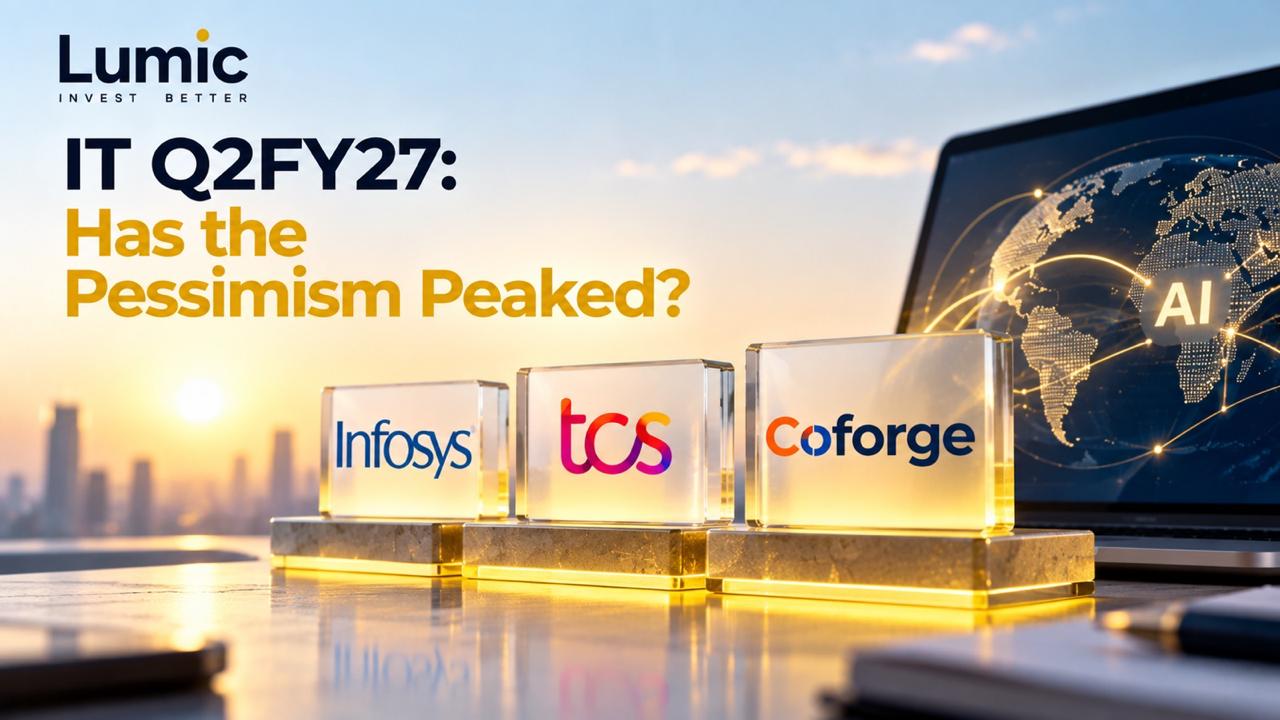
India's IT sector enters Q2FY27 with muted growth expectations. But the mood has changed. Investors are no longer as worried about a sharp collapse in IT demand. Valuations have fallen, AI fears have eased somewhat, and spending on cloud, data and digital projects is holding up in parts of the market.
The key question is no longer just: Will IT recover?
Can AI create enough new business to offset the pressure it puts on traditional IT services?
The Q2 Setup: Low Expectations for Large IT
Q2 is usually a seasonally stronger quarter. Yet brokerages expect only modest growth from the large IT companies.
- TCS: ~0.5% QoQ organic CC growth
- Infosys: ~1.1%
- Coforge: ~4.5% organic growth
Large IT = barely growing. Mid-tier IT = still finding opportunities.
Three Companies. Three Different Stories.
1. TCS — Can the Leader Regain Momentum?
TCS kicks off the IT earnings season on October 8. The Street expects about 0.5–0.6% sequential revenue growth. Profit margins could improve as the impact of earlier salary hikes fades. One estimate puts Q2 EBIT margin around 24.4%, compared with 24.0% in Q1. Deal wins are expected at around $10–11 billion, helped by the Porsche deal. The key question: Are deals simply being signed — or are they finally driving growth?
2. Infosys — The Guidance Test
Kotak expects around 1.1% organic CC growth, partly because a temporary Q1 setback is expected to reverse. The bigger issue is FY27 guidance. The Street increasingly expects a reduction from 1.5–3% to around 1.5–2.5%. At the lower end, that would imply almost no growth in the second half. Infosys needs to deliver the quarter and show that growth can improve without relying too heavily on acquisitions.
3. Coforge — The Standout
Coforge enters Q2 with a much stronger growth profile. Kotak expects around 4.5% organic sequential growth, driven by large deals and healthcare. Deal wins are expected above $800 million. Its FY27 margin targets remain strong: 20.5–21% EBITDA and at least 15.5% EBIT.
AI: The Opportunity and the Threat
AI is becoming both IT's biggest growth opportunity and IT's biggest pricing challenge.
AI helps IT companies complete projects with fewer people and fewer hours. That is good for clients. But it creates pressure on traditional IT providers. If a project once took 100 hours and AI reduces that to 60, the client may eventually ask: "Why should I keep paying for 100 hours?"
This is the core AI pricing problem. The productivity benefit may not stay with the IT company; some of it may be passed back to clients through lower prices.
AI Also Requires Heavy Investment
Becoming an AI-focused company is expensive. IT firms need to spend on AI tools and platforms, cloud and computing capacity, specialised employees, data capabilities, technology partnerships, training, acquisitions and proprietary software.
AI investment rises → Traditional billable work falls → Client pressure on prices increases → Employee productivity improves → Revenue per project may decline.
As a result, the shift to AI could be neutral for margins — or even hurt them — before the benefits become visible. The long-term opportunity is significant, but investors need proof that new AI, cloud, data and engineering businesses will be bigger than the revenue lost to lower prices.
Is the Worst Over?
Possibly — but it is too early to say.
-
Valuations have fallen. The Nifty IT index dropped roughly 25–30% during the first half of 2026 before recovering sharply. The correction has already priced in a large part of the fear around AI disruption.
-
Technology spending is not collapsing. Demand remains cautious, but it has not fallen off a cliff. Companies are still spending on AI, cloud, cybersecurity, data and digital transformation.
-
Mid-tier companies remain stronger. Coforge and other mid-tier companies continue to grow faster than the large IT firms. The question is increasingly what clients are buying, who they are buying it from, and how much they are willing to pay.
Q2: The Four Numbers That Matter
| Metric | TCS | Infosys | Coforge |
|---|---|---|---|
| QoQ CC revenue growth | ~0.5% | ~1.1% organic | ~4.5% organic |
| EBIT margin | ~24.4%; ↑ ~43 bps | Stable | Stable; FY27 ≥15.5% |
| Q2 deal wins | ~$10–11bn | ~$2–3bn | >$800mn |
| FY27 growth / guidance | ~2% CC growth | Possible cut to 1.5–2.5% | FY27 outlook intact |
Expectations vary by brokerage and depending on whether growth includes acquisitions. This is therefore a practical range, not a single forecast.
Read the table this way: large IT needs stabilisation, while mid-tier IT still needs to prove that faster growth can be sustained.
What Could Change the Story?
-
Deals turn into revenue. If deal wins remain strong but revenue does not improve, investors may stop viewing bookings as proof of a recovery.
-
AI revenue grows faster than AI-related price cuts. This is the biggest long-term test.
-
Prices remain firm. If all the benefit of AI productivity goes to clients, revenue growth will remain weak even when demand improves.
-
Optional spending returns. A real recovery requires companies to spend on new technology projects, not just cut costs.
Lumic Takeaway
The IT sector does not need a spectacular Q2 to surprise the market. Expectations are already low.
- Cost-cutting → technology investment
- AI fear → AI revenue
- Deal wins → actual growth
- Productivity gains → stronger profits
The most important part of Q2 may not be the headline profit number. It will be management's answer to one question: "Who is keeping the economic benefit of AI — the IT company or the client?"
If more of that benefit stays with IT companies, the sector's recovery could finally have a foundation. If not, AI may expand the technology market while weakening the economics of traditional IT services.
That is the real Q2FY27 debate.
Disclaimer: This article is for educational purposes only and does not constitute investment advice. Equity investments are subject to market risks. Please consult a SEBI registered investment adviser before making investment decisions.